


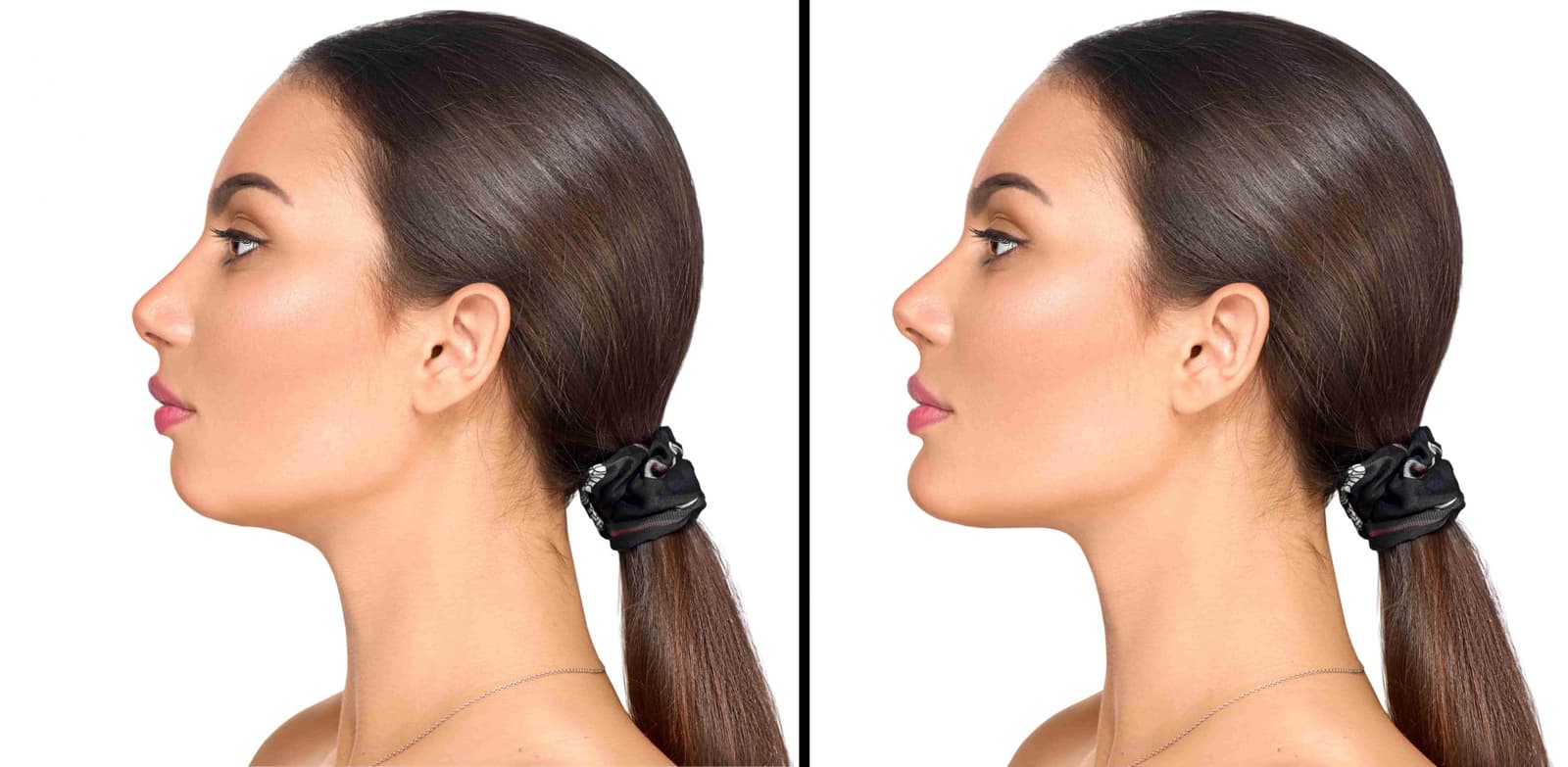
A well-defined chin can play an important role in facial balance and profile aesthetics. When the chin appears small, recessed, or disproportionate to the rest of the face, it can affect the overall appearance of the jawline and facial contours. Although both treatments can enhance the shape and projection of the chin, they work in very different ways. A chin implant is a surgical procedure that permanently places a medical implant around the existing chin bone, while chin filler is a minimally invasive treatment that uses injectable dermal filler to temporarily add volume and improve contour.
What Is a Chin Implant?
A chin implant, also known as chin augmentation, is a surgical procedure designed to increase the size and projection of the chin. During the procedure, a surgeon places a biocompatible implant around the existing chin structure.
Chin implants are commonly made from materials such as silicone and are available in different shapes and sizes. The surgeon selects an implant according to the patient's facial proportions, chin anatomy, and desired result.
The procedure is generally performed under local anesthesia with sedation or general anesthesia, depending on the surgical plan and the patient's circumstances. An incision may be made beneath the chin or inside the mouth, through which the implant is positioned and secured.
Advantages of Chin Implants
One of the biggest advantages of a chin implant is its ability to create more substantial and long-lasting chin projection. It can be particularly useful for people with significant chin retrusion or underprojection. Other potential benefits include:
Long-lasting enhancement
More noticeable structural projection
Improved facial proportions
Better definition of the chin and jawline
Ability to customize implant size and shape
Can provide a significant change with a single procedure
Because the implant physically changes the structure of the chin, the result can be more dramatic than what is usually achievable with a small amount of dermal filler.
Disadvantages and Risks
As a surgical procedure, chin augmentation involves greater risks and recovery requirements than injectable treatments. Possible complications can include infection, bleeding, implant displacement, asymmetry, changes in sensation, scarring, or the need for revision surgery.
Patients should also understand that an implant is a foreign material placed in the body. Although chin implants can provide long-term results, they may occasionally need to be adjusted or removed.
Recovery typically involves swelling and bruising, particularly during the first several days. The exact recovery period varies depending on the surgical technique and individual healing.
What Is Chin Filler?
Chin filler is a non-surgical facial aesthetic treatment that uses injectable dermal fillers to add volume and improve the shape, projection, and definition of the chin.
Hyaluronic acid (HA) fillers are commonly used for facial contouring because they can add volume while producing a relatively natural appearance. A qualified aesthetic practitioner injects the filler into carefully selected areas of the chin to create the desired contour.
Unlike an implant, filler does not physically enlarge the underlying bone. Instead, it creates additional soft-tissue volume that can make the chin appear more projected and defined.
Advantages of Chin Filler
Chin filler is popular among patients who want to improve their profile without undergoing surgery. Potential benefits include:
Minimally invasive treatment
Little or no downtime
No surgical incision
Results can be visible relatively quickly
Treatment can be customized
Useful for subtle contouring
Some hyaluronic acid fillers can be dissolved if necessary
Another advantage is flexibility. Because filler is temporary, patients can adjust their treatment over time. This can be appealing to someone who is unsure whether they want a permanent change.

Disadvantages and Risks
The main limitation of chin filler is that its results are temporary. Depending on the type of filler used, the treatment area, and individual factors, patients may need periodic maintenance treatments.
Possible side effects include swelling, bruising, redness, tenderness, lumps, asymmetry, or infection. Although uncommon, more serious complications can occur if filler is accidentally injected into a blood vessel. For this reason, chin filler should always be administered by a qualified and experienced medical professional.
Filler may also have limitations when a patient requires significant structural correction. Someone with a substantially recessed chin may achieve a better result with a surgical approach.
Chin Implant vs. Chin Filler: Key Differences
Although both treatments can improve chin appearance, several important differences should be considered.
Surgical vs. Non-Surgical
The most obvious difference is the treatment method. A chin implant requires surgery, an incision, anesthesia, and a recovery period. Chin filler involves injections and generally requires little downtime. For patients who want to avoid surgery, filler may be the more appealing option.
Longevity
Chin implants are designed to provide long-term augmentation, although they are not necessarily guaranteed to remain unchanged for life. Chin fillers are temporary. Their longevity depends on the specific product and individual factors, and repeat treatments may eventually be required.
Degree of Enhancement
Implants generally provide greater structural augmentation and may be better suited to patients who require substantial projection. Fillers are often more appropriate for mild to moderate deficiencies, subtle contouring, or patients seeking a relatively conservative change.
Recovery Time
Chin filler usually involves minimal downtime. Patients may experience temporary swelling or bruising but can often return to their normal activities relatively quickly. Chin implant surgery requires more recovery. Swelling and bruising can persist for days or weeks, and patients need to follow their surgeon's postoperative instructions carefully.

Reversibility
Some hyaluronic acid fillers can be dissolved with an enzyme called hyaluronidase if medically appropriate. An implant, however, requires a surgical procedure if it needs to be removed or replaced.
Cost
The initial cost of chin filler is generally lower than surgery. However, because filler requires maintenance, the cumulative cost over several years can increase. A chin implant typically involves a higher upfront expense but may provide long-lasting results without regular injections.
Who Is a Good Candidate for a Chin Implant?
A chin implant may be considered for adults who:
Have a noticeably recessed or underdeveloped chin
Want significant and long-lasting projection
Are in generally good health
Have realistic expectations
Are comfortable undergoing surgery
Want to improve facial balance or profile proportions
A consultation with a qualified plastic surgeon is essential to determine whether an implant is appropriate.
Who Is a Good Candidate for Chin Filler?
Chin filler may be suitable for adults who:
Want a subtle or moderate improvement
Prefer a non-surgical approach
Have mild chin retrusion
Want to improve chin definition
Are not ready for permanent surgical augmentation
Want to test how additional chin projection might look
However, not everyone is a suitable candidate for dermal filler. A medical professional should assess the patient's facial anatomy, medical history, medications, and aesthetic goals before treatment.
Chin Implant or Chin Filler: Which Is Better?
There is no universally "better" treatment. The right choice depends on the patient's anatomy, desired degree of correction, expectations, budget, and willingness to undergo surgery.
Chin filler may be preferable for someone seeking a subtle, temporary, and minimally invasive improvement.
A chin implant may be preferable for someone looking for more significant and long-lasting structural enhancement.
In some cases, patients may also benefit from other procedures, such as liposuction beneath the chin, neck contouring, or jawline treatments. A comprehensive facial assessment can help determine which combination, if any, is appropriate.

Conclusion
Both chin implants and chin fillers can improve chin projection, facial harmony, and jawline definition, but they serve different purposes. The best treatment depends on individual facial anatomy and aesthetic goals. Anyone considering either procedure should consult a qualified medical professional who can assess their face and explain the potential benefits, limitations, risks, and expected results.
Read More